
Mill Creek could be getting quite a bit bigger, and some neighborhoods that people already think of as Mill Creek may officially become part of the city.
If you live south of the current city limits, particularly near the Bothell-Everett Highway corridor, this is something worth paying attention to.
On October 13, 2026, the Mill Creek City Council voted to move forward with plans to pursue annexation of an area known as Mill Creek South. The proposal could add approximately 11,700 residents to the city.
Nothing has been annexed yet, and there are still decisions to be made. The city is looking at January 1, 2028, as a possible effective date.
Want to learn more about the proposed annexation?
The City of Mill Creek is hosting a community town hall on Tuesday, November 17, 2026, from 6:00 to 7:30 p.m. at the Henry M. Jackson High School Library, 1508 136th St. SE.
Residents will have an opportunity to review detailed maps, learn about the proposed boundaries and possible changes to city services, and speak directly with City Councilmembers and staff. I'll be there, too!
What caught my attention was why Mill Creek wants to expand, which neighborhoods could be included, and what this might mean for the people already living there.
Where Is Mill Creek Looking to Expand?
One of the interesting things about Mill Creek is that the city limits don't necessarily match what people think of as Mill Creek.
There are established neighborhoods, shopping areas, and businesses with Mill Creek mailing addresses that are actually in unincorporated Snohomish County.
The city has been studying several possible annexation areas and narrowed its initial focus to two options.
One included neighborhoods south of the current city limits. The other was considerably larger, extending farther east and potentially doubling Mill Creek's population.
The council decided to pursue the southern area first, identified in the city's planning documents as blocks C, D, and H.
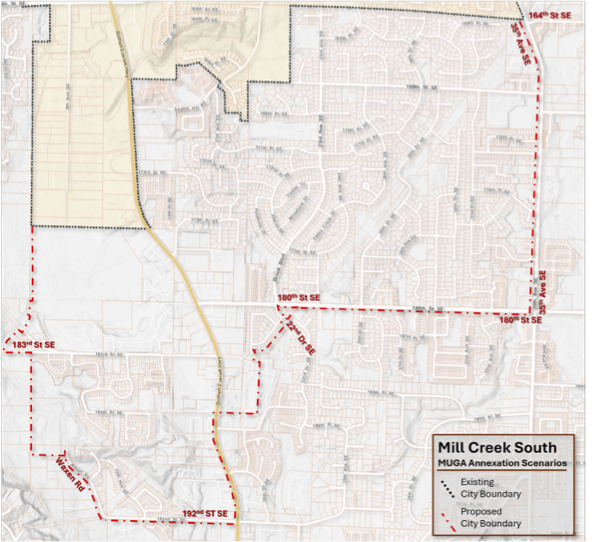
The proposed area includes portions of the Highway 527 corridor extending toward 192nd Street SE, along with neighborhoods near 180th Street SE and 35th Avenue SE. North Creek Park is also included in the proposal.
The boundaries are more specific than those road descriptions, so I would encourage anyone living nearby to look at the city's map rather than assume their neighborhood is included.
Mill Creek Has Expanded Before
This isn't the first time Mill Creek has considered expanding its boundaries.
In 2005, the city annexed the Thomas Lake area near 132nd Street SE and Seattle Hill Road, bringing approximately 553 acres and 2,200 additional residents into Mill Creek.
That annexation also involved discussions about commercial development, tax revenue, and the cost of providing city services.
I find that interesting because some of those same questions are coming up again, more than 20 years later.
The current proposal is considerably larger in terms of population, with approximately 11,700 residents potentially joining the city.
It also raises a familiar question: Can Mill Creek expand its boundaries while maintaining the services and community character that residents value?
Why Does Mill Creek Want to Annex More of Snohomish County?
Mill Creek is considering annexing additional neighborhoods to strengthen its long-term finances and have more influence over development near its existing city boundaries.
A big part of the answer comes down to money and how the city plans for its future.
Mill Creek faces rising costs for services, staffing, and infrastructure, just as other cities do. The city is looking for ways to strengthen its revenue and maintain services over the long term.
Annexing additional neighborhoods would bring more residents into the city, along with commercial properties that generate sales tax revenue.
According to the financial analysis presented to the council, the proposed Mill Creek South annexation could generate approximately $2.7 million more in annual revenue than expenses in 2028. That projected annual benefit grows to about $5.3 million by 2045.
Those are estimates based on the consultant's financial model, not guaranteed results.
There is another reason the city is interested in expanding, and I think this one is just as important.
Mill Creek wants more influence over how the surrounding area develops.
Growth doesn't stop at a city boundary. New housing, commercial development, roads, and infrastructure can affect the people living in Mill Creek even when those projects are technically outside city limits.
Annexation would give the city more direct involvement in decisions affecting the areas it brings within its boundaries.
How Would Mill Creek Annexation Affect Homeowners in the Proposed Area?
If the proposed annexation moves forward, homeowners in the affected neighborhoods would become Mill Creek residents, although the exact impact on property taxes, city services, and development regulations hasn't been determined yet.
This is where I think the conversation gets especially interesting.
We're not talking about an entirely new development where people will eventually move in. These are established neighborhoods with existing homes, businesses, and residents.
If your neighborhood becomes part of Mill Creek, you would be living within a different local government jurisdiction.
That raises some practical questions.
Would your property taxes change? Which city services would you receive? Would development regulations be different? What happens to the infrastructure and parks already serving those neighborhoods?
The answers aren't all available yet.
The city still needs to work through service agreements, infrastructure responsibilities, and the financial details of bringing these areas into Mill Creek.
For homeowners, I would pay particular attention to the eventual property tax comparison. The city's projected financial benefit doesn't tell us whether an individual homeowner would pay more or less.
I also wouldn't assume that becoming part of Mill Creek automatically increases a home's value. Buyers consider the whole picture, including location, condition, schools, services, and the cost of owning the property.
We need more information before drawing conclusions about what annexation would mean for a particular home.
What Concerns Have Been Raised About the Mill Creek South Annexation?
The October 13 council discussion raised questions about the financial projections, infrastructure responsibilities, and how much community outreach has taken place so far.
The vote was 6-0, with one councilmember abstaining.
Councilmember Cavaleri raised concerns about the assumptions behind the financial projections, including housing market conditions and potential infrastructure expenses.
Other council members supported moving forward while acknowledging that additional planning and community input would be needed.
One detail that caught my attention was the discussion about infrastructure around North Creek Park and Mays Pond, including drainage and culverts.
Those may not be the first things residents think about when they hear the word annexation, but they're exactly the kinds of responsibilities a city needs to understand before expanding its boundaries.
The consultant indicated that estimated costs had been incorporated into the financial analysis, while acknowledging that some questions still need to be worked through.
The consultant also acknowledged that community outreach had been limited so far. More opportunities for residents to learn about the proposal and provide input are expected as the process moves forward.
Is Mill Creek Planning to Annex More Neighborhoods?
For now, Mill Creek is concentrating on the neighborhoods to the south, but there has also been some discussion about eventually expanding farther east of the city.
During the presentation, the consultant described a possible three-to-five-year vision that could include additional areas east of Mill Creek.
That larger expansion has not been approved, and the council's October 13 direction was to focus on Mill Creek South.
It's still something I'd watch if I lived east of the current city limits.
When Could the Mill Creek South Annexation Happen?
The proposed Mill Creek South annexation could take effect as early as January 1, 2028, although the timeline depends on several planning and approval steps.
During the remainder of 2026, the city expects to continue planning, coordinate with Snohomish County, and begin additional community outreach.
A December 2026 council study session is expected to address the implementation plan and how annexation could proceed.
One of the decisions still to be made is whether the city would use an interlocal agreement or pursue a process involving voter approval.
Much of the formal boundary review and implementation work would take place during 2027, with January 1, 2028, identified as a possible effective date.
There is still a lot to work through before any city boundaries change.
Why I'm Following This
I find these kinds of local decisions interesting because they can shape a community long before we see the results.
We tend to notice the new homes, road construction, and commercial development happening around us. Decisions about city boundaries and local services are less visible, even though they can have a lasting impact.
For Mill Creek, this proposal is about more than adding residents. It's also about the city's financial future and how much influence it wants over growth along its boundaries.
For the people already living in the proposed annexation area, I think the most important questions are still ahead, particularly around taxes, services, and how the city plans to manage the additional responsibilities.
I'll continue following the process as those details become clearer.
If you live in one of the neighborhoods being considered, I'd be curious to hear what you think. Would you welcome becoming part of Mill Creek, or are there questions you'd want answered first?
