
There’s a new option for Washington homeowners when putting their home on the market, and if you’re thinking about selling, it’s worth understanding before you decide how your home will be marketed or when it will officially go “Active.”
It’s called NWMLS First Look. You may hear it compared to “Coming Soon,” but First Look works differently. A home can be shown to buyers, have open houses, and even receive and accept an offer while still in First Look, before it ever reaches Active status.
That raises some important questions for homeowners. Who can see your home during First Look? Where is it being advertised? Could you be limiting your exposure to potential buyers? And when might First Look actually work in your favor?
First Look isn't automatically good or bad. What matters is understanding what you're choosing before deciding whether it belongs in the marketing plan for your home.
What Is NWMLS First Look and How Does It Work?
First Look is a new optional listing status offered by Northwest Multiple Listing Service (NWMLS). It became available September 4, 2026, and gives a homeowner the option to place their home in First Look for up to 21 days before moving to Active status.
What makes First Look different from what you might think of as “Coming Soon” is that the home doesn’t necessarily have to sit there waiting for a future launch date. Depending on the seller’s choices, showings may take place, open houses may be held, and the seller may receive and accept an offer while the home is still in First Look.
That means a home could potentially sell during First Look without ever reaching Active status.
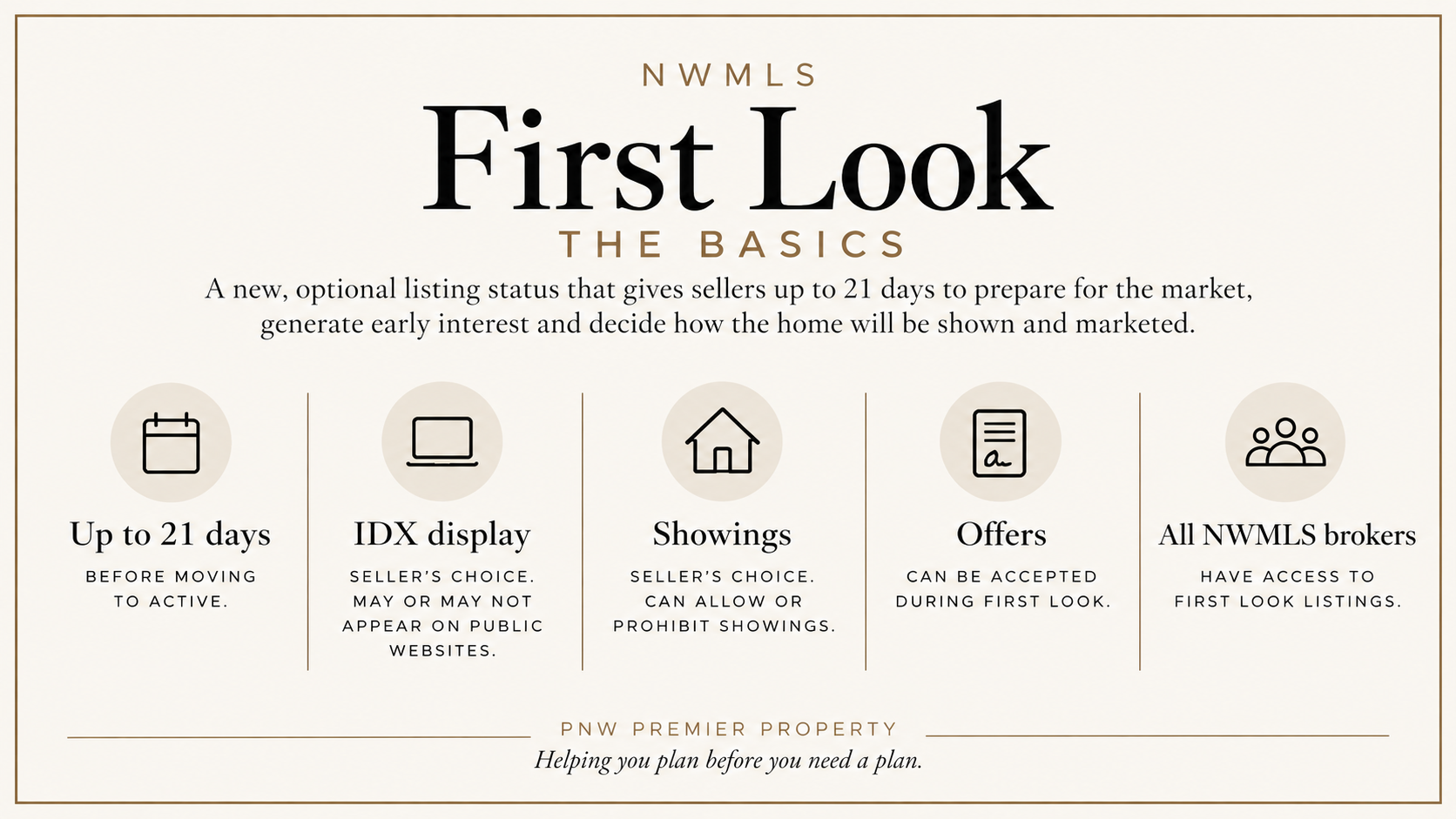
NWMLS First Look basics for Washington homeowners, including the 21-day period, IDX display, showings, offers, and broker access.
Where Can Buyers See a First Look Home?
A First Look listing is available within NWMLS to its member brokers, but whether buyers can see it on public real estate websites depends on whether the listing is distributed through IDX. Importantly, the seller, not the broker, chooses whether the listing will be distributed through IDX.
Buyers want to know whether they could be missing homes that are already available for showings or offers. Sellers need to understand who may, or may not, see their home before deciding how they want it marketed.
Not to bore you, but IDX is the system that allows MLS listing information to appear on real estate websites outside of the MLS itself. For example, when you search for homes on a real estate brokerage or agent’s website and see listings from many different companies, that listing information is typically being supplied through an IDX feed.
That matters because many buyers search for homes online themselves, even when they are already working with an agent. If the seller chooses not to have a First Look listing distributed through IDX, those buyers may not see the home in the places they normally search.
What Does Washington Law Require?
Washington law requires residential real estate marketed to a limited or exclusive group of prospective buyers or brokers to be concurrently marketed to the general public and all other brokers, except as reasonably necessary to protect the health or safety of the owner or occupant.
RCW 18.86.130, which took effect in 2026, states that a broker may not market the sale or lease of residential real estate to a limited or exclusive group of prospective buyers or brokers unless the property is concurrently marketed to the general public and all other brokers.
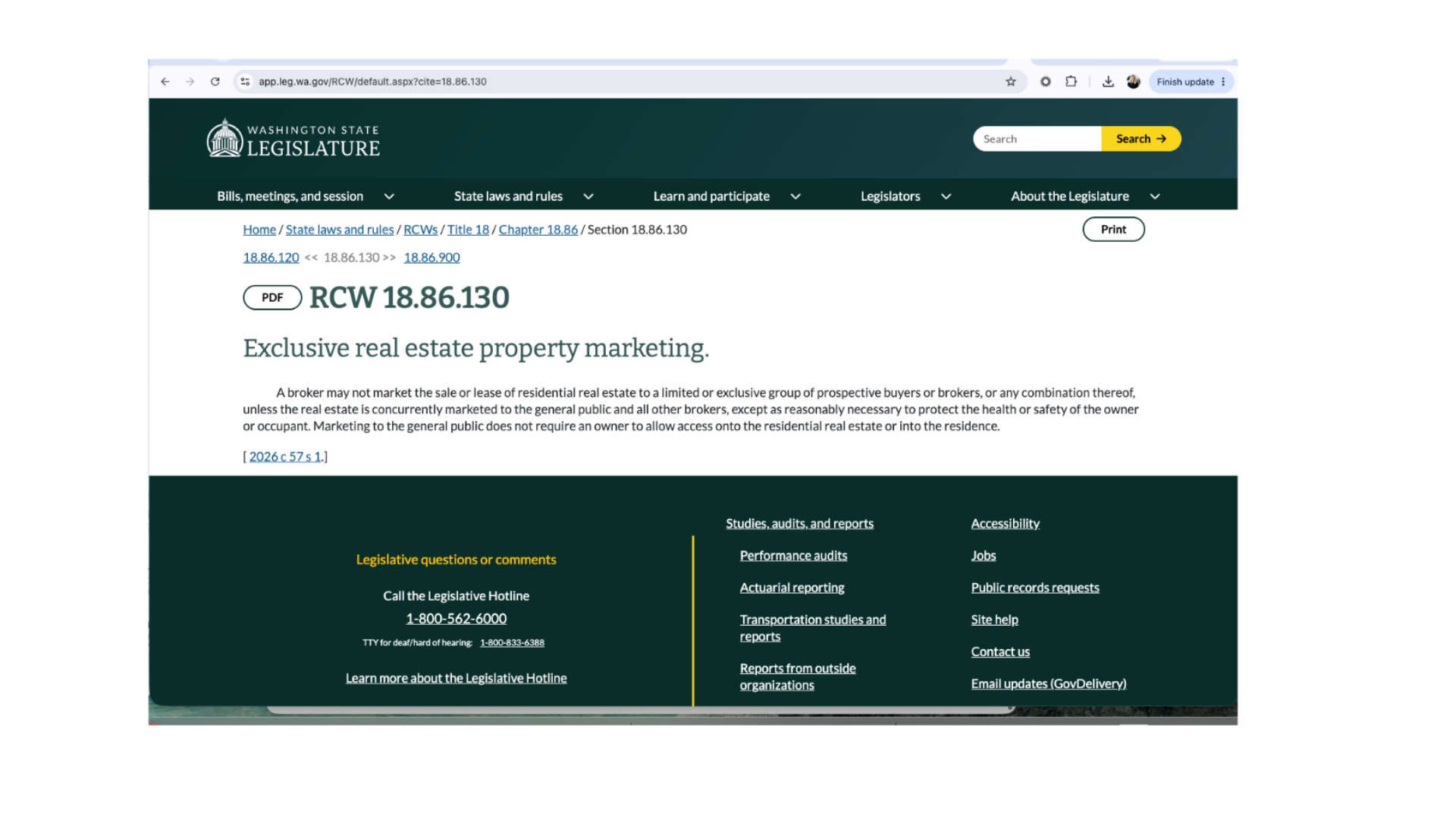
Washington State RCW 18.86.130 regarding exclusive real estate property marketing and the requirement to concurrently market residential real estate to the general public and all other brokers.
In other words, the marketing needs to happen at the same time. A home can't first be marketed only to a limited group and then later marketed to everyone else.
Here’s where it gets less clear: the law doesn’t spell out exactly what marketing to the “general public” has to look like.
That leaves an important question with First Look. If a seller chooses not to have the listing distributed through IDX, what other marketing is enough to meet that requirement?
I called NWMLS directly for clarification on this point. The person I spoke with said that, as a safe approach, they recommend allowing the listing to be distributed through IDX.
So What Is NWMLS Telling Brokers to Do?
NWMLS has given brokers a fairly clear starting point: keep the First Look listing distributed through IDX.
NWMLS describes keeping First Look distribution through IDX as the “fail-safe” approach. With IDX distribution turned on, the listing is sent to thousands of public-facing real estate websites, helping ensure the home is being marketed to the general public while it is also available to brokers through NWMLS.
A seller can choose not to have the home distributed through IDX during First Look, but NWMLS advises that this option be used sparingly. When that choice is made, the listing firm is responsible for making sure the home is still being marketed publicly in a way that complies with Washington law, and the seller must sign an additional form acknowledging that choice.
What Actually Counts as Marketing to the General Public?
Washington law does not provide a specific checklist for what qualifies as marketing to the “general public.”
There has been a lot of discussion about First Look within the real estate industry, including on videos and podcasts, and there are different interpretations of what “marketing to the general public” actually requires when IDX is not being used.
Does a social media post qualify? An agent’s website? An open house? A combination of different marketing efforts?
I’m not an attorney, nor do I play one on TV, so I’m not going to give a legal answer where there isn’t a clear one. What I can do is stay current on the guidance we’re given and make sure my clients understand their options before making a decision about how their home will be marketed.
What Choices Does a Seller Have With First Look?
A seller has several choices with First Look. Your home can stay in First Look for up to 21 days before moving to Active, or it can move to Active sooner. You can decide whether your home appears on public real estate websites, whether showings are allowed, and whether you are willing to consider and accept an offer during First Look.
That flexibility could be useful. Maybe your home is still being prepared for sale, but you want buyers and brokers to know it’s coming. You might want to begin building interest while photography, staging or other preparations are being completed. NWMLS specifically identifies early marketing during listing preparation as one potential use for First Look.
There’s another side to consider. If you allow showings and accept an offer during First Look, your home could potentially sell before it ever reaches Active status. That’s why decisions about exposure, showings and timing should be considered as part of the overall marketing strategy for your home.

First Look listing visibility can affect whether Washington home buyers find a home in the places they normally search.
Can Buyers Miss a Home Listed in NWMLS First Look?
Yes, it’s possible for a buyer to miss a home listed in NWMLS First Look. A First Look home may already be available for showings, and the seller may even be willing to accept an offer while the home is still in First Look.
There’s another important detail: existing NWMLS saved searches and automatic listing emails do not automatically include First Look listings. Brokers need to update those searches to include First Look as a status.
For a buyer, that means a First Look home could potentially be missed. For a seller, it raises an equally important question: could some of the buyers who might be interested in your home miss it, too?
That becomes especially important if IDX distribution is turned off during First Look. NWMLS cautions that some buyers may not see that the property is for sale, and thousands of real estate websites may continue to show the home as “Not for Sale” or “Off Market.”
I’ve already seen examples of homes listed in First Look that are not appearing on the independent real estate websites where many buyers search. In some cases, these homes appear ready to be fully marketed, with professional photos and complete listing information, yet they are not receiving that broader online exposure.
There may be a strategic reason to limit exposure during First Look, but it should be a choice made with a clear understanding of how it could affect who sees the home.
Should I Use NWMLS First Look When Selling My Home?
NWMLS First Look may make sense when selling your home if you have a specific reason for marketing it before moving to Active status. It isn’t necessarily a good or bad strategy. It depends on what you’re trying to accomplish and how First Look is being used.
It could make sense when a home isn’t quite ready for Active status but the seller wants to begin creating awareness while final preparations are underway. NWMLS specifically identifies staging, photography, social media and other marketing during listing preparation as potential uses for First Look. It may also be useful for a unique property where early feedback could help inform the marketing or pricing strategy.
A seller can also choose not to allow showings during First Look. If showings are turned off, that applies to everyone, including the listing firm. Open houses, broker previews and buyer visits are not allowed until showings are turned on.
The bigger question for me is not whether First Look is good or bad. It’s whether there is a clear reason for using it for your particular home. The strategy should start with what you’re trying to accomplish, and then the marketing choices should support that goal.
What Happens When First Look Ends?
When First Look ends, the home moves to Active status unless it has already gone pending, been canceled or withdrawn. A home can remain in First Look for up to 21 days, but it does not have to stay there for the full 21 days and can move to Active sooner.
Here’s another detail sellers should understand…the time spent in First Look does not become part of the public Days Active when the home moves to Active. Price changes made during First Look are also not displayed on public IDX websites. Days Active begins at zero when the listing becomes Active.
The First Look history doesn’t disappear, though. NWMLS retains the time spent in First Look and any price changes within its systems, and brokers can share that information with their clients.
For a seller, that distinction is worth understanding. A home may look brand new to the public when it becomes Active, but it may already have been marketed, shown, received buyer feedback or even had its price changed during the First Look period.
Are There Any Concerns With NWMLS First Look?
Yes, there are some concerns being raised about NWMLS First Look, particularly around how a home is marketed, who may see it, and what could happen if an offer is accepted before the home ever reaches Active status.
Some of those concerns deserve discussion, but First Look itself is not a pocket listing. Every First Look listing must be entered into NWMLS and is available to all NWMLS brokers and their clients. It cannot be held within one brokerage and marketed only to that company’s agents or buyers.
Dual agency is a separate issue. First Look does not require or automatically create dual agency. A listing broker could potentially represent a buyer interested in a First Look property, just as dual agency can occur with an Active listing.
There are other questions we probably won’t be able to answer until we see how buyers and sellers respond to First Look over time.
Will some sellers use the First Look period to test a higher price knowing that price changes made during First Look won’t appear on public IDX websites? Will buyers begin treating First Look homes differently and wait to see whether a home moves to Active or changes price? Will buyers understand that a seller may already be accepting offers during First Look, or will some assume they should wait?
Those are questions about how people may respond to this new status, not predictions about what will happen. We’ll need some time and actual market experience before we know.
What we do know is that First Look changes some of the information buyers see and gives sellers new choices before a home reaches Active status. That makes it important not only for your agent to understand First Look, but to understand how to use it correctly.
Your agent should be able to explain why they are recommending First Look for your home, how your home will be marketed while it is in First Look, who will be able to see it, whether showings and offers will be allowed, and what you may gain or give up with each choice.
New rules and marketing options will continue to come along. Part of my job is staying current on those changes, asking questions when the answers aren’t clear, and making sure my clients understand how those changes could affect them before we make a decision.
The Bottom Line for Washington Homeowners
First Look can be a useful option for Washington home sellers, but whether it makes sense depends on how it will be used to market your particular home.
Where will your home be marketed? Will it be distributed through IDX? Will showings or offers be allowed? And what is the reason for using First Look instead of going directly to Active?
Those are questions worth answering before your home goes on the market.
If your agent recommends First Look, they should be able to explain why they believe it makes sense for your home, how your home will be marketed while it is in First Look, who will be able to see it, whether showings and offers will be allowed, and what you may gain or give up by using it.
If you're considering selling a home in Snohomish or North King County and want to talk through whether First Look belongs in the marketing strategy for your home, schedule a conversation.
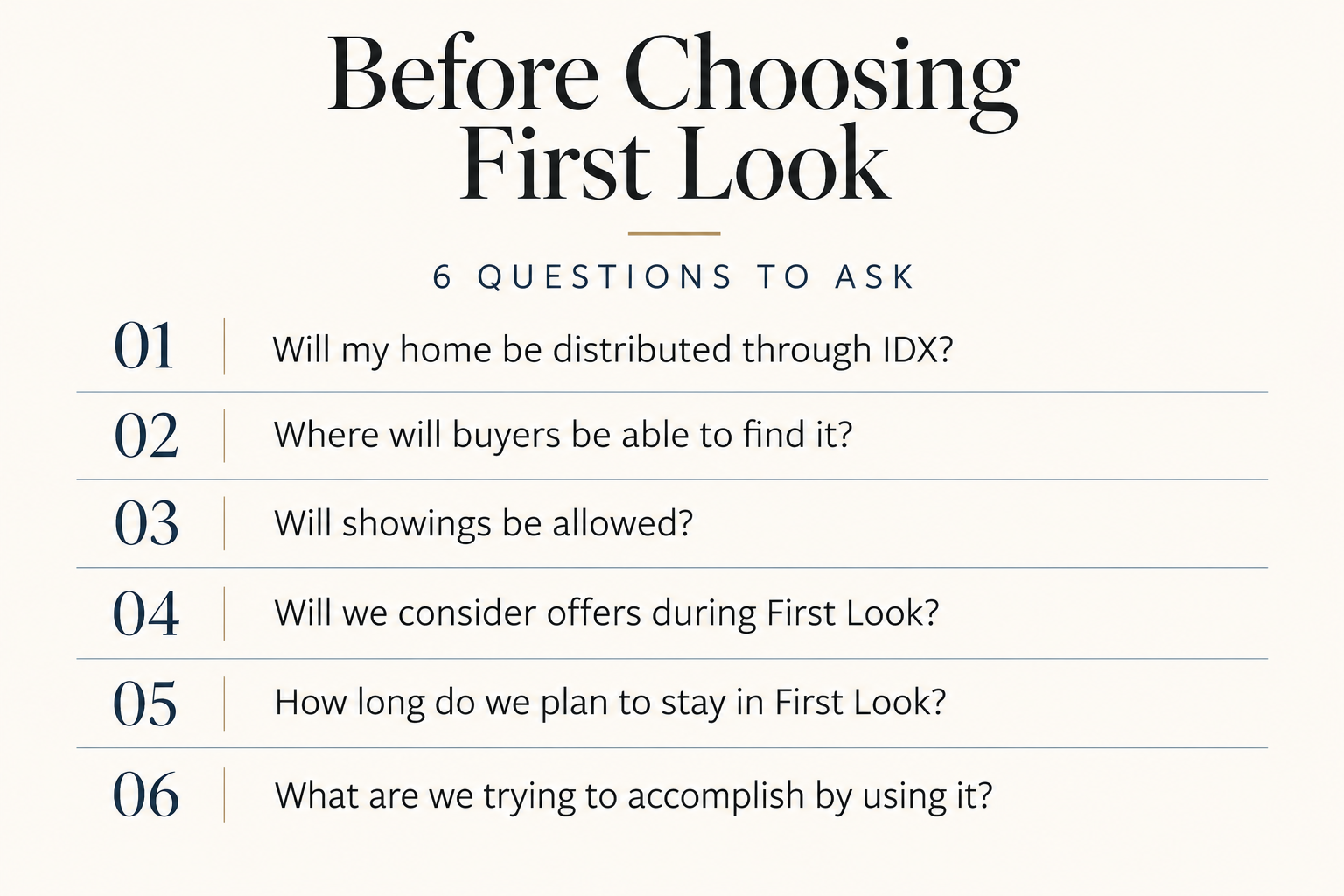
Six questions Washington home sellers should ask before choosing NWMLS First Look for their listing.
DISCLAIMER: This article is for general informational purposes only and is not intended as legal advice. Real estate laws, MLS rules and policies may change, and how they apply can depend on the specific circumstances. Buyers and sellers should consult with their real estate broker and, when appropriate, a qualified attorney regarding their individual situation.
